
The Problem Positioning Solves
Ask most small business owners what makes them different and you will hear some version of “great service and quality.” Their competitors say the same sentence. When every business in a market claims the same virtues, customers cannot tell anyone apart — so they choose on price, and everyone’s margins bleed. A brand positioning strategy is the deliberate work of ending that blur: choosing the one idea you want to own in your customer’s mind, and then making every part of the business prove it.
Positioning is not a logo, a slogan, or a mission statement on a wall. It is the answer to a harder question: when a customer describes you to a friend in one sentence, what do you want that sentence to be? This guide helps you find that sentence and build around it.
Step One: Name the Audience Precisely
“Everyone” is not an audience; it is the absence of one. Positioning starts by narrowing: which specific group of people has the problem you solve best, values what you do most, and is easiest for you to reach? A bakery that positions for busy parents who want real ingredients without a special trip will make different promises — and different products — than one positioning for celebration cakes. Both can thrive. The one that tries to be both usually becomes neither in the customer’s mind.
Talk to your ten happiest customers and ask why they chose you and what they would miss if you closed. Their answers, in their words, are positioning raw material no competitor research can give you. Notice the patterns: speed, honesty, expertise, warmth, specialisation. One of those patterns is probably your real difference, hiding in plain sight.
Step Two: Find the Difference You Can Prove
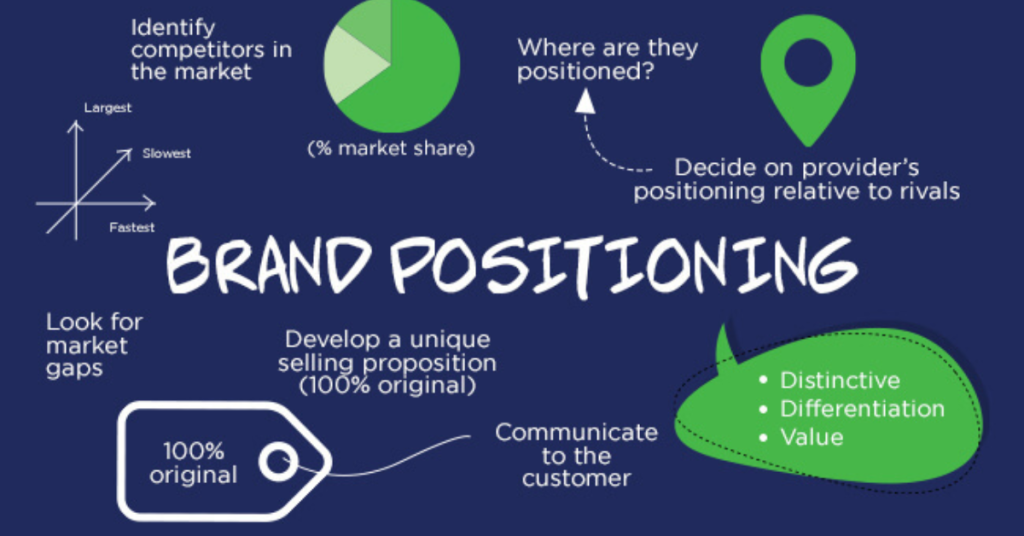
A position is a promise, and a promise you cannot keep is just advertising. List the differences you could claim — fastest turnaround, deepest specialisation, the only one who does X, the one who serves Y specifically, the premium craft option, the radically simple option — and grade each on two tests. Is it true today, provable with evidence? And does the audience from step one actually care? The difference that passes both tests is your position. The rest are decorations.
This is where storytelling earns its keep: the proof of a position is usually a story — how the business started, what it refuses to do, the customer it rescued. If you have not shaped yours yet, work through the craft in brand storytelling that turns your history into a reason to buy, because a position stated without a story sounds like a claim, and a position carried by a story sounds like the truth.
Step Three: Say It in One Line
Compress the position into a single sentence using this skeleton: “For [audience], we are the [category] that [difference], unlike [the usual alternative].” A plumber might land on: “For homeowners who hate waiting, we are the plumbers who arrive the same day, unlike firms that book you in next week.” That sentence is not necessarily your public slogan — it is your internal compass. Every decision gets tested against it: does this offer, this page, this hire make the sentence more true or less?
Say the line out loud to someone outside the business. If they immediately get it and can repeat it a day later, you have a position. If they nod politely and forget it, sharpen it. Memorable beats clever: the goal is to be the name that surfaces in the customer’s mind at the moment of need, which is also why positioning and SEO for brand visibility reinforce each other — a clear position gives your content a clear target.
Step Four: Make Everything Prove It
A position lives or dies in the details customers touch. If you are the fast option, your website must answer in seconds, quote in minutes, and show real response times. If you are the specialist, your content must go deeper than generalists dare — the kind of depth a structured content marketing plan is built to produce. Pricing, packaging, photography, the way the phone is answered: each is either evidence for the position or static against it. Audit the ten most common customer touchpoints and ask of each, honestly, “does this prove our sentence?”
Expect this step to involve saying no. Positioning is sacrifice: the fast plumber declines the huge commercial contract that would slow response times; the specialist refuses work outside the specialism. The businesses that stand out are the ones willing to be wrong for some customers in order to be unmistakably right for others.
How Long Positioning Takes to Work
Positioning is not a campaign with a launch date; it is a direction you hold for years. Realistically, you will feel it first in sales conversations — prospects arriving pre-sold on your difference — within a few months of consistency, and in pricing power within a year. The condition is consistency: changing the message every quarter resets the clock to zero, because customers file you in their minds slowly, through repetition. Pick the sentence, prove it weekly, and let time compound it.
One warning before you start: do not position by attacking competitors by name. A position built on “unlike those other firms” ages badly and makes you sound smaller. State what you are, prove it relentlessly, and let customers draw the comparison themselves — they will, and a conclusion a customer reaches on their own is worth ten claims you make about yourself.
The Bottom Line
A brand positioning strategy is a choice: a precise audience, a provable difference, one memorable sentence, and the discipline to make every touchpoint prove it. Small businesses do not lose to bigger competitors; they lose to blur. Choose your sentence this week, test it against your happiest customers, and start aligning the details — the market rewards the business it can describe.